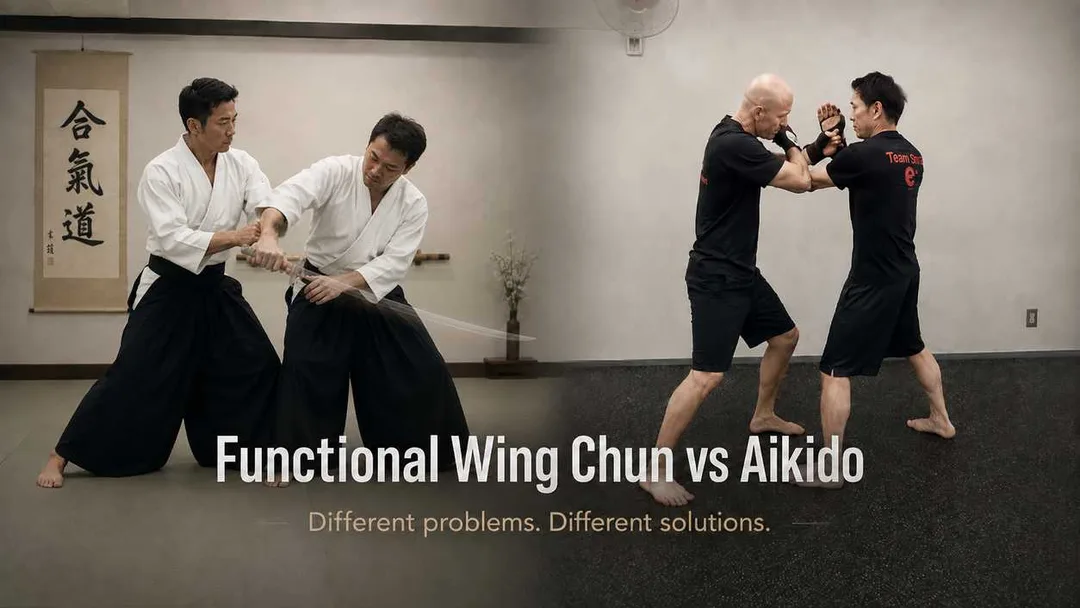
The pictures illustrates the Weapon Ghost of Aikido compared to me applying short range techniques. FWC is trying to prevent the opponent from hurting you, aikido is often trying to break out of a grab in order to use a weapon (that is no longer present)
Functional Wing Chun vs Aikido
Two Martial Arts Designed to Solve Different Problems
When martial arts are compared, the discussion often becomes a question of which style is stronger or which techniques “work.”
I think there is a better question to ask first:
What problem was this martial art designed to solve?
Different martial arts were developed for very different situations.
Some evolved around competition. Some around weapons. Some around restraining people. Others were shaped by the idea of resolving conflict while causing as little damage as possible.
When the problem changes, the techniques, distance, tactics and training methods naturally change with it.
Next to Wing Chun, Aikido is the martial art I practised for the longest time.
So I am not looking at Aikido from the outside and simply asking whether it “works.” I spent years enjoying it, training seriously and trying to understand how I could make it work better for the kind of self-defense situations I was interested in.
Eventually, that process taught me something more important.
Sometimes the problem is not that a martial art is badly designed.
Sometimes it is simply designed for a different problem.
1. What Was Aikido Designed to Do?
To understand why Aikido looks the way it does, it helps to look at where it came from.
Aikido developed largely from Daitō-ryū aiki-jūjutsu, a much harsher system containing strikes, throws, joint attacks and immobilization techniques. Morihei Ueshiba gradually transformed that material into an art with a less destructive purpose, but many of the older tactical assumptions remained inside the techniques.
One of the most important was the presence of weapons.
If someone is preventing you from drawing a weapon, attempting to draw their own, reaching for the handle of your sword or attacking with a blade, controlling the wrist and arm makes a great deal of sense.
So does moving away from the line of attack while taking control of the dangerous limb and reaching the opponent’s side.
The large, committed attacks commonly seen in Aikido also make more sense when viewed through this history. Shōmen-uchi, yokomen-uchi and tsuki resemble decisive cuts and thrusts much more than the short punches commonly seen in modern unarmed violence.
I think of this as the ghost of the weapon inside Aikido.
The weapon may no longer be present in ordinary practice, but its influence remains in the distance, the attack lines, the emphasis on wrist control and the desire to move outside the opponent.
As Ueshiba moved the older material in a safer and less destructive direction, cooperation also naturally became more important.
A joint cannot be safely destroyed in practice. A partner has to be given time to respond. A throw has to allow enough space for ukemi. Both people have to understand the movement well enough to practise it repeatedly without seriously injuring each other.
The large committed attacks and relatively limited resistance of much modern Aikido are therefore not completely arbitrary.
They are connected to the history of the system and to the way dangerous techniques were made possible to practise safely.
2. What Does Aikido Do Exceptionally Well?
There are several things I think Aikido teaches extremely well.
Movement, posture, ukemi and whole-body coordination are among its clearest strengths.
Practitioners spend a great deal of time learning to step, turn, change direction and move the entire body rather than trying to solve everything with the arms.
That can create very good body awareness.
Ukemi is especially valuable.
Learning how to fall, roll and recover without panicking is useful far beyond martial arts. Becoming comfortable with losing balance and knowing how to protect yourself when you hit the ground is a genuinely practical skill.
Aikido also gives people the opportunity to explore quite complicated movements with another person without heavy resistance constantly stopping the exercise.
Because both partners know what is being practised, they can spend time studying posture, distance, footwork, timing and the shape of a throw or lock.
That cooperation is also what creates much of Aikido’s characteristic flowing feeling.
When you are performing the technique, it can feel as though you are effortlessly sending another person across the room.
I certainly experienced that feeling.
But the person receiving the technique understands what is happening too. They are moving in a way that allows the technique to continue and lets them fall safely.
The flow is therefore not created by one person alone.
Both partners are creating the movement together.
That does not make the practice meaningless. It simply tells us what kind of skill is actually being developed.
And it can be tremendous fun.
The movement feels good. The techniques are interesting. A good dojo is a social place where people can train together for many years without needing to turn every class into a contest.
That is one of the reasons I stayed with Aikido for as long as I did.
3. Where Might Aikido Be Less Suited to Self-Defense?
This is where I eventually began to struggle.
Aikido is often described as a “soft” martial art.
I now think that description can be misleading.
Aikido often looks soft because the training is cooperative. That does not necessarily mean the solution itself is soft.
Imagine that someone grabs your wrist.
In a real self-defense situation, there may be several relatively gentle solutions.
You could prevent the grab.
You could remove the hand.
You could change the distance.
You might simply disengage and leave.
Aikido, however, often uses the grab as the starting point for a wristlock, throw or pin.
That creates an interesting contradiction.
The wrist is a small and delicate joint.
It is difficult to catch on someone who does not want you to catch it, difficult to hold when they are pulling away, and especially difficult to control when the other person is larger and actively resisting.
During normal practice, the lock can be applied gradually. The partner recognizes the pressure, follows the movement and falls before the joint is damaged.
Against genuine resistance, there may be no such opportunity.
Apply the lock slowly and the person may pull away, rotate, strike with the other hand or simply escape.
Apply it quickly enough to prevent that, and the opponent may not have time to move safely before the joint is injured.
This creates a strange situation:
Applied safely, the lock may be difficult to keep on a resisting person. Applied fast enough to prevent resistance, it may no longer be a particularly gentle solution.
If someone has merely grabbed you, seriously damaging their wrist may also be far more force than the situation requires.
So when discussing “soft” martial arts, I think we should distinguish between soft-looking practice and solutions that actually allow us to use less violence.
They are not always the same thing.
Control techniques can certainly have value.
I have worked in security, and I know that restraining someone can sometimes be necessary.
But there is an enormous difference between three people controlling one resisting person and one person trying to do the same job alone.
With two or three people, the problem can be divided. One person controls an arm, another controls the body, and someone else can manage the legs or assist with restraint. Alone, the situation changes completely.
While you are trying to control one wrist, the person still has another hand. They can pull away, punch, grab, tackle or reach for something.
To control a fully resisting person without injuring them, a clear advantage in size, weight, strength or numbers is extremely useful.
Without that advantage, a “control” technique can quickly become a joint-breaking technique simply because that is the amount of force required to stop the resistance.
There is another problem that became even more important to me:
How do you reach the position required for the technique in the first place?
Many Aikido techniques begin with a clear attack line, an extended arm and an opponent committing strongly enough for you to enter, turn and reach the outside.
Modern unarmed attacks often behave very differently.
Punches can be short and fast.
The hand returns immediately.
There may be a second punch before you have finished dealing with the first.
The attacker can stop, change direction, withdraw the arm or rotate to continue facing you.
If you move to their side, they are under no obligation to remain facing the original direction.
When a weapon is involved, controlling that dangerous arm can justify a large tactical commitment.
Without the weapon, the attacker is free to change the problem almost immediately.
Again, we see the ghost of the weapon.
For me, however, the biggest problem was that the attack was normally known beforehand.
You know which wrist will be grabbed.
You know where the strike is coming from.
You usually know which technique you are practising.
The technique itself may be difficult, but the problem has already been defined for you.
Real violence does not work that way.
You may be pushed, punched, grabbed or headbutted.
The first attack may change into something else halfway through.
Several things may happen almost at once.
There is very little time to recognize what is happening, select an answer and perform a long technique.
And if the situation changes, continuing to force the original technique can create another problem.
I spent a long time trying to fix this.
I thought I needed to practise faster.
Add resistance.
Modify the techniques.
Make my Aikido more realistic.
Eventually I realized that I was trying to make a tool designed around one kind of problem solve a very different one.
That was the turning point for me.
4. How Does Functional Wing Chun Approach the Same Problem?
Functional Wing Chun begins earlier.
Self-defense does not start when somebody has already grabbed or hit you.
It begins with awareness, readiness and distance.
Students learn how to recognize developing danger, prepare without unnecessarily escalating the situation and make decisions while there are still options available.
That means learning to deal with uncertainty itself.
You do not know what the attacker is going to do.
So instead of building everything around:
“If they do this, perform this technique,”
we first ask whether the attack can be prevented from succeeding at all.
Whenever possible, the first goal is prevention.
If physical engagement becomes necessary, the objective is not normally to capture a small joint and keep the person under prolonged control.
We want to interfere with their ability to continue attacking.
Improve our position.
Affect their structure.
Move forward when appropriate.
Create an opportunity to escape or finish the immediate danger.
FWC does contain some control methods, but I warn students about them.
The more you try to control another person, the more risk you often accept yourself.
You remain connected longer.
Your hands become occupied.
You may become less mobile.
The opponent has more time to punch, grab, escape, reach for a weapon or wait for someone else to become involved.
And if you want to restrain someone safely without unnecessarily injuring them, having an advantage in size, strength, weight or numbers makes an enormous difference.
Without that advantage, control may only become reliable when enough force is used to damage the person.
For that reason, control is not our default answer.
The basic idea is simpler:
Prevent the attack when possible.
Engage early when necessary.
Do not allow the attacker to continue freely.
Create an opportunity to escape or end the immediate danger.
And if the situation changes, change the answer.
There is no reason to remain loyal to a technique that no longer fits the problem.
If the way is clear, continue.
If something stops you, identify what is stopping you.
Clear it and continue.
That ongoing problem-solving process is at the heart of Functional Wing Chun.
5. Who Is Likely to Benefit Most From Each Approach?
If practical self-defense is a reason for training, I would choose Functional Wing Chun.
FWC is based on traditional Wing Chun, but its training has been deliberately shaped around the problems a modern person may realistically face.
You do not know whether somebody will punch, push, grab, tackle or continue attacking.
You may not know whether there is one person or several.
So the training is not based on knowing the attack beforehand.
Students learn to prevent attacks when possible, deal with short and fast attacks, work against resistance and keep solving the problem when the first solution does not work.
I also think this gives FWC a different interpretation of what a “soft” solution can be.
Punching sounds violent.
Joint locks often sound controlled and humane.
In reality, things are not always that simple.
A basic series of straight punches combined with forward pressure can interrupt an attack and strongly discourage someone from continuing without requiring us to capture and damage a small joint.
Of course, strikes can cause injury. A split lip or nosebleed is certainly possible.
But in many situations that may still be far less damaging than explosively applying a wrist, elbow or shoulder lock hard enough to stop a resisting person.
And importantly, we do not need to remain attached to the opponent afterwards.
FWC also tries not to remain permanently behind the action.
Aikido generally begins after the opponent has initiated an attack.
That is already difficult against one person.
Against several people, being continually reactive becomes even more problematic because while you are dealing with one attack, somebody else is free to move.
The same problem appears when you need to protect somebody besides yourself.
Avoiding an attack yourself may not be enough if the person next to you is the actual target.
This is why FWC spends so much time on prevention, positioning, initiative and engagement.
Rather than only asking how to respond after someone acts, we try to influence whether they are able to act freely in the first place.
But I would not choose FWC only because of self-defense. It is also enjoyable, social and physically interesting.
Once resistance is introduced, a large part of training becomes problem solving.
You try to move forward and your partner stops you.
- Why?
- Did they take the center?
- Did your structure collapse?
- Are you applying pressure in the wrong direction?
- Can you change the angle?
- Can you break their structure?
- Can you go around the obstruction or create another opening?
You have to figure it out while the other person is trying to solve their own problem at the same time.
I often describe it as chess with your body.
There is also something similar to grappling in it.
Both people are continuously trying to improve position while the other person resists.
But we normally remain standing, and we do not have a gi to grab and hold the opponent in place.
If your solution depends on grabbing something and refusing to let go, you may simply get stuck with it.
Instead, you have to keep reading the changing pressure, structure and position and find another route.
That is one of the things I enjoy most about FWC.
Different people create different problems.
There is rarely only one correct answer.
And as you become more experienced, the training does not become boring because you have memorized all the techniques.
The problems become more interesting.
If practical self-defense is not your priority, Aikido can be a very enjoyable martial art.
You can learn movement, posture and excellent ukemi.
You can enjoy the flowing techniques and spend years training with people you like.
I certainly did.
But if you want to learn how to protect yourself, I think there is one distinction worth understanding:
Being good at applying a technique to a cooperating attacker is not the same ability as protecting yourself against a resisting person.
I learned that distinction the hard way.
During my first years of Aikido I trained seriously. People around me told me I was becoming good at it, and I believed I was progressing well.
Then I encountered difficult situations outside the dojo and discovered that I could do far less than I expected.
My first conclusion was that my Aikido was not good enough.
- So I trained more.
- I tried to make it work against stronger resistance.
- I tried to adapt it to shorter punches.
- I tried to make the training more realistic.
- For a long time, I was essentially trying to “fix” my Aikido.
- Eventually I reached a different conclusion.
It was not broken. It was a tool designed for a different job.
The weapon-influenced attack lines, the committed movement and the cooperation that allows the techniques to be practised safely are not simply mistakes that can be removed one by one.
If you remove all of them, add short punches, continuous attacks and genuine resistance, at some point you are no longer improving Aikido.
You are beginning to create something else. That is something I wish I had understood before I started.
If you want to practise Aikido because you enjoy movement, ukemi, technical study and training cooperatively with other people, there is nothing wrong with that at all. There is plenty to enjoy.
If your main goal is learning how to deal with dangerous situations, unpredictable attacks and the problem of protecting yourself or somebody else, I believe Functional Wing Chun is the better fit.
Both arts can be practised by people who are big or small, strong or not, young or old.
In fact, we have quite a few former Aikido practitioners at FWC, and some people continue training in both.
So this is not really a question of saying:
“Aikido is bad and Functional Wing Chun is good.”
The more useful question is:
Does the problem your martial art is training you to solve match the problem you actually want to be prepared for?
Once that is clear, choosing a martial art becomes much easier.